Research · Chang Gung University Intelligent Control Lab · Aug 2024 – Jun 2025
Dynamic Hand-Gesture Recognition with MobileNet + GRU
Static gesture classifiers look at one frame at a time, so they can't tell a left swipe from a right swipe. This model reads the whole clip. A pre-trained MobileNet extracts what each frame shows, and a GRU learns how it moves.
- Test accuracy
- 85%
- Baseline (RNN + GRU)
- 66%
- Test loss
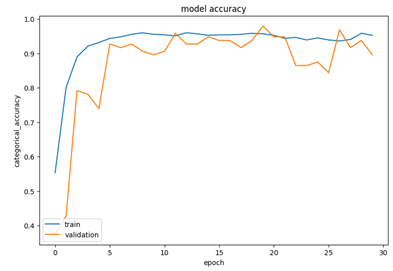
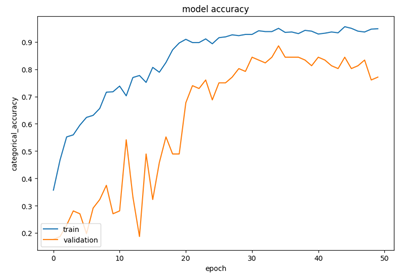
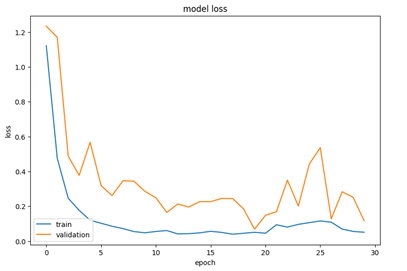
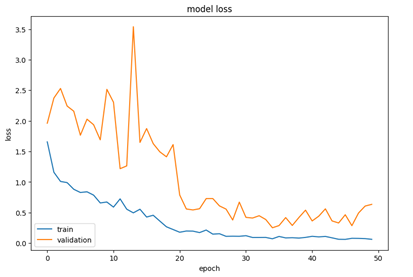
- 0.342 vs 1.1513
- Presented
- Poster, 20th Formosa Plastics Applied Tech. Seminar
Results: explore the confusion matrices
These are the real test-set results from the paper. Switch models to see where the baseline breaks down. It mixes up the swipes and pauses, while MobileNet + GRU's only real weakness is left swipes.
27/32 correct · 84.38%
Hover a bar to inspect it. Drag to rotate. Blue = correct, orange = mistakes.
Per-class precision / recall / F1
| Class | Precision | Recall | F1 | Confusion row (pred. 0–4) |
|---|---|---|---|---|
| Left swipe | 1.00 | 0.50 | 0.67 | [4, 2, 0, 2, 0] |
| Right swipe | 0.67 | 1.00 | 0.80 | [0, 6, 0, 0, 0] |
| Pause | 1.00 | 1.00 | 1.00 | [0, 0, 6, 0, 0] |
| Thumbs down | 0.75 | 1.00 | 0.86 | [0, 0, 0, 6, 0] |
| Thumbs up | 1.00 | 0.83 | 0.91 | [0, 1, 0, 0, 5] |
Approach
- 01
Frames
Each 30-frame clip trimmed to frames 7–26 and downsampled to 96×96.
- 02
MobileNet
Pre-trained CNN, wrapped in TimeDistributed, extracts spatial features per frame.
- 03
Compress
Pooling halves height and width, then features are flattened per time step.
- 04
GRU (128)
Models temporal order. Dropout of 0.3 limits overfitting.
- 05
Softmax
Five classes: left/right swipe, pause, thumbs down/up.
Why this design: transfer learning from MobileNet gives strong spatial features without a large dataset, and MobileNet is light enough to point toward real-time, on-device use. GRUs capture temporal dependencies with fewer parameters than LSTMs and avoid the vanishing gradients of plain RNNs.
No data augmentation, on purpose: flipping or reversing a clip would turn a left swipe into a right swipe. Direction is the label.
Data & training
- Open Kaggle dataset (Hand Gesture Detection System): 763 clips, each 30 frames covering 2–3 seconds, recorded waist-up.
- Roughly 84 / 12 / 4% train / validation / test split, randomized and balanced across classes, with early stopping on validation.
- Optuna Bayesian search (Tree-structured Parzen Estimator), 50 trials, picked: GRU 128 units, dense 64 units, learning rate 0.001.
- Cross-entropy loss, batch size 32, trained on an NVIDIA RTX 4060 in about 15 minutes.
What I'd do next
- Evaluate on a larger held-out set. 32 test clips make each mistake worth about 3 points of accuracy.
- Try temporal augmentation that keeps direction (speed jitter, crops) and Transformer-based temporal models.
- Swap in MobileNetV3 and quantize for real-time inference on a phone.
Paper
Regarding a MobileNet and GRU-based Dynamic Hand-Gesture Recognition Model
Peng-Ru Hou, Tz-Jing Lee, Yeong-Hua Chang
Poster, 20th Formosa Plastics Corp. Applied Technology Seminar
Affiliations: Chang Gung University, Dept. of Electrical Engineering; Kang Chiao International School.